

Magnificent Expectations
Market prices reflect what investors expect to happen in the future. When a group of stocks delivers returns far above the broad stock market, it’s likely these companies surprised investors in a good way.
This principle is challenging to uncover in the data because the market’s expectations are hard to quantify, even with the benefit of hindsight. Sure, we can compare a company’s reported earnings against what was forecast by analysts. But there’s dispersion in analysts’ forecasts. And sometimes earnings reports are accompanied by messaging from the company about its future business that impacts prices. So, a company can beat its earnings forecast and still experience a price decline.
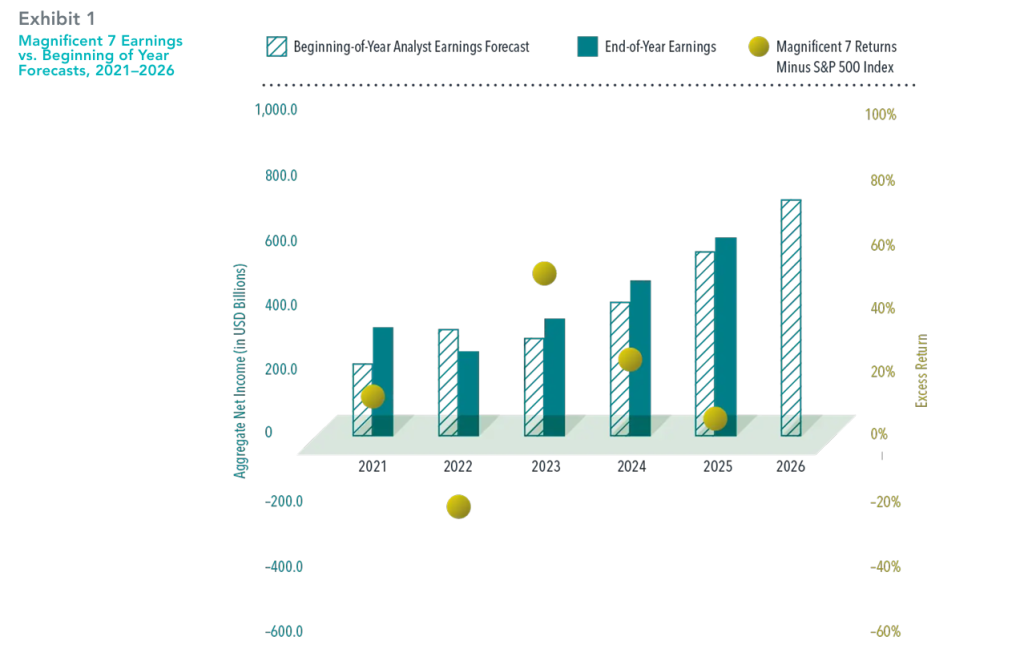
All that said, sometimes we see strong indicators of earnings surprises. Recent years for the Magnificent 7 stocks are a good example. From 2021 through 2025, aggregate earnings for these companies exceeded average beginning-of-year expectations in all but one year, 2022. Their stocks outpaced the broad market in all but one year. I bet you can guess which year they underperformed.
Obviously, we don’t yet have 2026 results. But forecasted earnings for the Mag 7 are even higher this year. That means a potentially higher bar these companies must clear such that they can deliver outsized returns
If you'd like to discuss how these themes relate to your own financial planning objectives, and to assess whether your portfolio is appropriately diversified rather than overly concentrated in the Magnificent Seven, please feel free to get in touch.
Risks : Buying Investments can involve risk. The value of your Investments and the income from them can go down as well as up and is not guaranteed at anytime. You may not get back the full amount you invested. Information on past performance is not a reliable indicator for future performance.
In USD. Source: Dimensional and FactSet, calculated by Dimensional. The Magnificent 7 stocks are represented by Tesla, Meta, Alphabet, Amazon, Nvidia, Apple, and Microsoft. Magnificent 7 Returns are a weighted average of the seven companies. Beginning of Year Earnings Forecast is the sum of average next 12-month net income analyst estimates for each Magnificent 7 stock as of December 31 of the prior year. End of Year Earnings is the sum of actual reported trailing 12-month net income for each Magnificent 7 stock as of December 31 for the stated year. Indices are not available for direct investment; therefore, their performance does not reflect the expenses associated with the management of an actual portfolio.
S&P data © 2026 S&P Dow Jones Indices LLC, a division of S&P Global.
Risks : Buying Investments can involve risk. The value of your Investments and the income from them can go down as well as up and is not guaranteed at anytime. You may not get back the full amount you invested. Information on past performance is not a reliable indicator for future performance. This information is intended for educational purposes and should not be considered a recommendation to buy or sell a particular security. The views expressed here are subject to change without notice and we can’t accept any liability for any loss arising directly or indirectly from any use of it.
To discuss your financial requirements or obtain other information click below

Share this article with your friends by clicking below

Value vs Growth
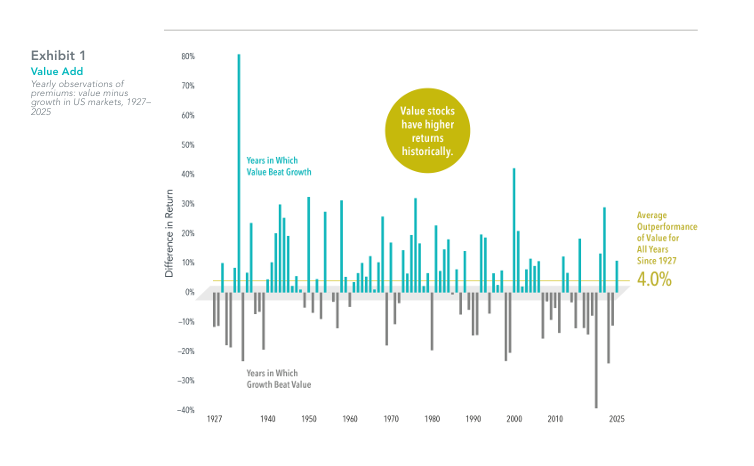
Historically, value stocks have outperformed growth stocks in the US (the largest stock market in the world) often by a striking amount. Data covering nearly a century backs up the notion that value stocks—those with lower relative prices—have higher expected returns.
While disappointing periods emerge from time to time, the principle that lower relative prices lead to higher expected returns remains the same. Value premiums have often shown up quickly and in large magnitudes. For example, in years when value outperformed growth, the average premium was nearly 15%. On average, value stocks have outperformed growth stocks by 4.0% annually in the US since 1927, as Exhibit 1 shows.
A consistent focus on value stocks is essential to capturing these outsize value premiums when they appear. Value investing is based on the premise that paying less for a set of future cash flows is associated with a higher expected return. That’s one of the most fundamental tenets of investing. Logic and history support a commitment to value stocks so investors can be positioned to take part when those shares outperform in the future.
Risks:Buying investments can involve risk. The value of your investments and the income from them can go down as well as up and is not guaranteed at any time. You may not get back the full amount you invested. Information on past performance is not a reliable indicator for future performance.
Fama/French Indices: The Fama/French indices represent academic concepts that may be used in portfolio construction and are not available for direct investment or for use as a benchmark. Index returns are not representative of actual portfolios and do not reflect costs and fees associated with an actual investment.
Currency and Premiums: In US dollars. Yearly premiums are calculated as the difference in one-year returns between the two indices described.
Value Minus Growth: Fama/French US Value Research Index minus the Fama/French US Growth Research Index.
Fama/French US Value Research Index: Provided by Fama/French from CRSP securities data. Includes the lower 30% in price-to-book of NYSE securities (plus NYSE MKT (formerly AMEX) equivalents since July 1962 and Nasdaq equivalents since 1973).
Fama/French US Growth Research Index: Provided by Fama/French from CRSP securities data. Includes the higher 30% in price-to-book of NYSE securities (plus NYSE MKT (formerly AMEX) equivalents since July 1962 and Nasdaq equivalents since 1973).
Backtested Performance: Results shown during periods prior to each index's inception date do not represent actual returns of the respective index. Other periods selected may have different results, including losses. Backtested index performance is hypothetical and is provided for informational purposes only to indicate historical performance had the index been calculated over the relevant time periods. Backtested performance results assume the reinvestment of dividends and capital gains.
GLOSSARY
Value Stock: A stock trading at a low price relative to a measure of fundamental value such as book equity.
Growth Stock: A stock trading at a high price relative to a measure of fundamental value such as book equity.
Value Premium: The return difference between stocks with low relative prices (value) and stocks with high relative prices (growth).
Risks : Buying Investments can involve risk. The value of your Investments and the income from them can go down as well as up and is not guaranteed at anytime. You may not get back the full amount you invested. Information on past performance is not a reliable indicator for future performance. This information is intended for educational purposes and should not be considered a recommendation to buy or sell a particular security. The views expressed here are subject to change without notice and we can’t accept any liability for any loss arising directly or indirectly from any use of it.
To discuss your financial requirements or obtain other information click below
Share this article with your friends by clicking below
Outpacing Inflation with Stocks
Inflation is back in the news of late, as the year-over-year change in the consumer price index is at the highest level since 2023 in the US which is the worlds largest economy. This may stoke fears of further inflation for many investors.
It’s important to note that expected inflation is incorporated into the expected returns demanded by market participants. To the extent inflation is expected to impact either future cash flows from an investment, or the discount rate applied to these cash flows, market prices adjust to compensate, resulting in positive expected real returns. This is borne out in historical data. Average real returns for the broad US stock market, based on the S&P 500 Index, have been positive even in years when US inflation was above the historical median. Average real returns for US small cap and small cap value stocks have been even higher, implying investors should not shy away from tilting toward higher expected return stocks even if inflation expectations are elevated.
We believe one way for investors to deal with inflation is to outpace it. Stocks have been a good way to do this historically, as the evidence from the US illustrates.
To review the diversification of your own investments feel free to get in touch.
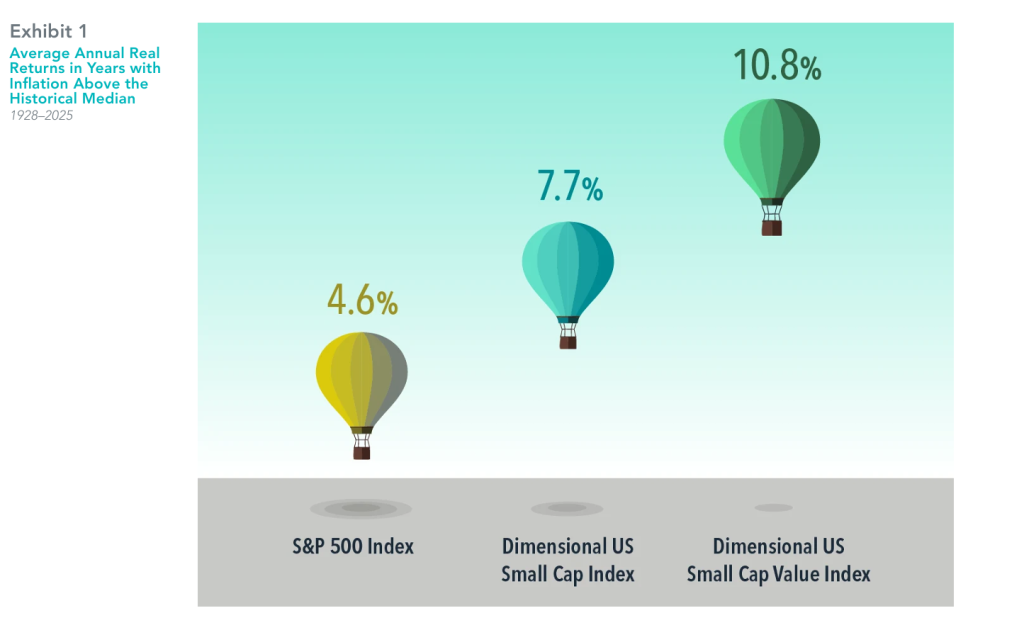
In USD. US inflation is the annual rate of change in the consumer price index for all urban consumers (CPI-U, not seasonally adjusted) from the US Bureau of Labor Statistics. Nominal return is the rate of return on an investment without adjusting for inflation. Real return is the rate of return on an investment after adjusting for inflation. Real returns are calculated using the following method: [(1 + nominal return) / (1 + inflation rate)] – 1. The Dimensional indices represent academic concepts that may be used in portfolio construction and are not available for direct investment or for use as a benchmark. Index returns are not representative of actual portfolios and do not reflect costs and fees associated with an actual investment.
See “Index Descriptions” in the appendix for descriptions of the Dimensional index data.
S&P data © 2026 S&P Dow Jones Indices LLC, a division of S&P Global. Indices are not available for direct investment.
Risks : Buying Investments can involve risk. The value of your Investments and the income from them can go down as well as up and is not guaranteed at anytime. You may not get back the full amount you invested. Information on past performance is not a reliable indicator for future performance. This information is intended for educational purposes and should not be considered a recommendation to buy or sell a particular security. The views expressed here are subject to change without notice and we can’t accept any liability for any loss arising directly or indirectly from any use of it.
To discuss your financial requirements or obtain other information click below
Share this article with your friends by clicking below
Key steps to take before the tax year ends
With the 2025/26 tax year-end approaching, now is the time to act to maximise your financial opportunities. Key priorities include using your £20,000 ISA allowance for tax-efficient growth and contributing up to £60,000 (or more if carry forward is available and relevant earnings are sufficient) to your pension to take advantage of tax relief and long-term benefits. Other allowances, such as Capital Gains Tax, Dividend Allowance and Junior ISAs, are ‘use it or lose it’ opportunities. On page 08, we explain why early action avoids last-minute stress, secures tax savings and ensures financial growth.
With rising life expectancy, more of us will need long-term care, making early financial planning essential. Fees have surged, and regional cost disparities add to the challenge. Funding options include annuities, insurance, investments and equity release. On page 12, we consider how professional advice is crucial for navigating tax implications and securing a sustainable plan for future care needs.
Inheriting wealth can be life-changing but comes with challenges. On page 28, we explain why holding excessive cash may not be the best choice as inflation erodes its value. Instead, consider diversified investments to foster growth. Align your strategies with your goals, whether it’s retirement or supporting your family, and seek professional advice to maximise tax benefits and avoid pitfalls.
Financial uncertainty is growing, with many feeling life is unpredictable. Rising inflation, energy costs, and tax increases fuel concerns, prompting shifts such as increased cash savings and delayed retirements. While saving is important, balancing short-term needs with long-term investments is key. Reviewing pensions and seeking advice builds resilience and confidence. Turn to page 06.
A complete list of the articles featured in this issue appears opposite page and on page 03.
Wealth planning for your future

Risks : Buying Investments can involve risk. The value of your Investments and the income from them can go down as well as up and is not guaranteed at anytime. You may not get back the full amount you invested. Information on past performance is not a reliable indicator for future performance. This information is intended for educational purposes and should not be considered a recommendation to buy or sell a particular security. The views expressed here are subject to change without notice and we can’t accept any liability for any loss arising directly or indirectly from any use of it.
To discuss your financial requirements or obtain other information click below
Share this article with your friends by clicking below
Mind the Gap - Diversifying Across Countries
While many of us enjoy an international holiday this summer it might be timely to talk about countries!
Recently, there’s been a lot of noise around which country one should invest their savings in for the best growth, and the idea of allocating away from the US for many reasons. In the first half of 2025, developed markets outside the US returned 19.0%, outperforming the US and emerging markets. But that outcome masks the wide range of returns across individual countries, from Spain’s 43.0% to Denmark at −5.5%. This kind of dispersion isn’t unusual—it’s a defining characteristic of global investing.
On average, the difference in return between the best- and worst-performing country
exceeded 43% over the past 10 calendar years. It’s no wonder investors may be tempted to chase recent winners or try to avoid losers. However, there’s little evidence that timing strategies consistently pay off. Country returns can turn quickly. For example, Canada posted the worst returns in 2015, down over 24%, but was the top performer in 2016, up over 24%. An investor who lost patience at the end of 2015 potentially missed out on the subsequent market recovery.
Country volatility is a normal part of global investing. Fortunately, as 2025 illustrates,
investors in a globally diversified portfolio can benefit from international diversification
without risking getting on the wrong side of country swings.
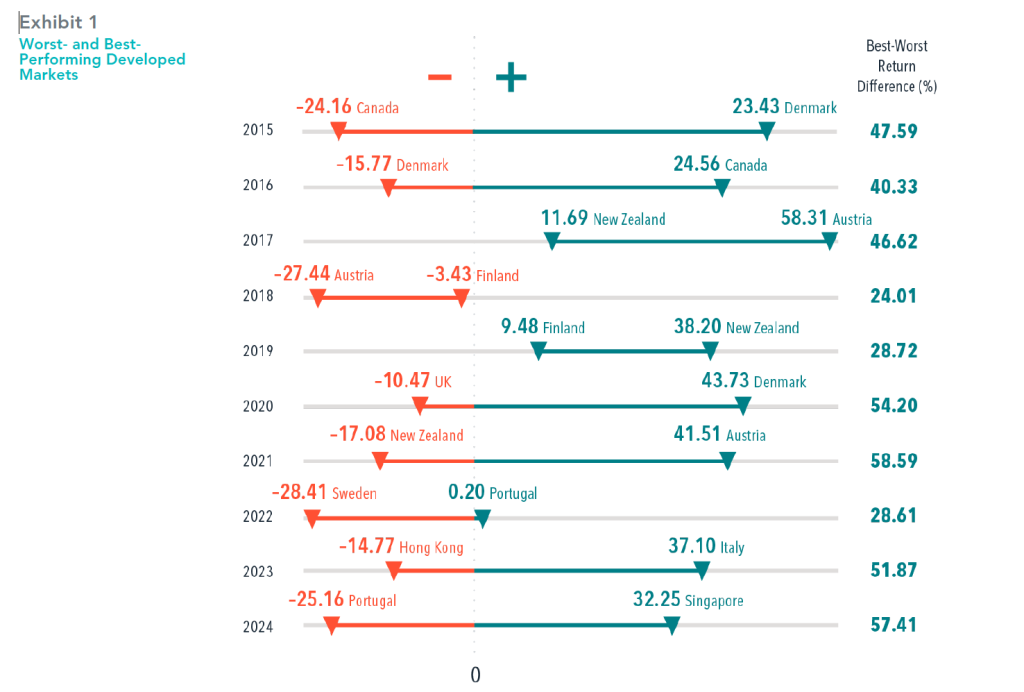
In USD. The US is included in the developed markets analysis. MSCI data © MSCI 2025, all rights reserved. Indices are not available for direct investment; therefore, their performance does not reflect the expenses associated with the management of an actual portfolio. Diversification neither assures a profit nor guarantees against a loss in a declining market.
Risks : Buying Investments can involve risk. The value of your Investments and the income from them can go down as well as up and is not guaranteed at anytime. You may not get back the full amount you invested. Information on past performance is not a reliable indicator for future performance. This information is intended for educational purposes and should not be considered a recommendation to buy or sell a particular security. The views expressed here are subject to change without notice and we can’t accept any liability for any loss arising directly or indirectly from any use of it.
To discuss your financial requirements or obtain other information click below
Share this article with your friends by clicking below
MARKET INSIGHTS: The Cost of Trying to Time the Market
Considering how dire the headlines and stock price moves appeared to be in April with the Tariff headlines I know it’s tempting to move to the sidelines and delay making investments or even sell and wait and see how things develop with a view to ‘re-entering the market’ when valuations might be more attractive and the outlook clear. The problem is the evidence suggests that approach rarely works out! With new record highs being made in the US stock market last week I thought it’s worth reflecting on this.
The impact of being out of the market for a short time can be profound, as shown by this hypothetical investment in the MSCI World Index, a broad Global stock market benchmark.
- A hypothetical £1,000 investment made in 2015 turns into £3,214 for the 10-year period ending December 31, 2024.
- Miss the MSCI World’s best week, and the value shrinks to £2,940. Miss the best three months, and the total return falls to £2,498.
- There’s no proven way to time the market—targeting the best days or moving to the sidelines to avoid the worst. Staying invested and focused on the long term helps to ensure that you’re in position to capture what the market has to offer.
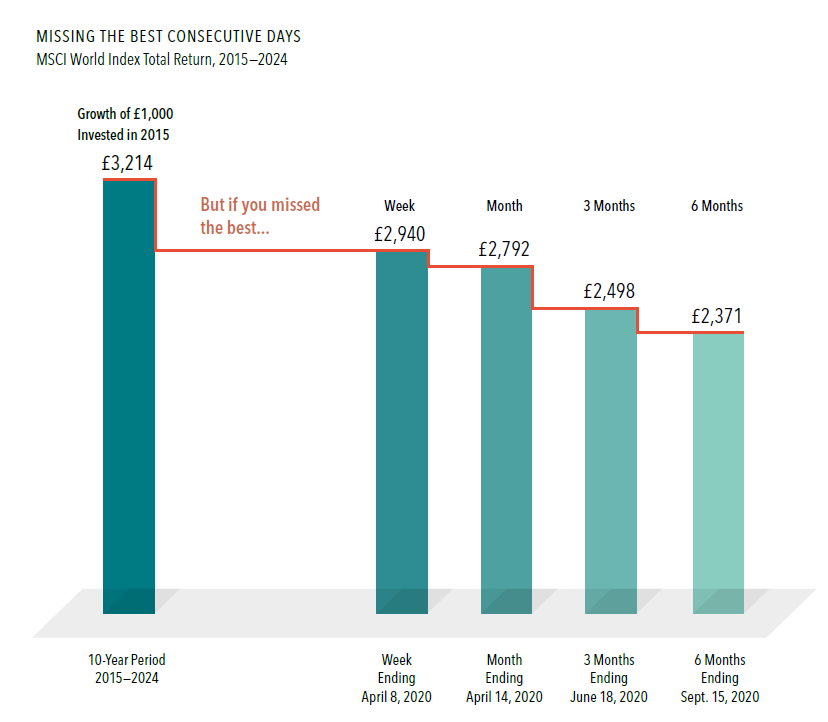
In GBP. For illustrative purposes. Best performance dates represent end of period (April 08, 2020, for best week; April 14, 2020, for best month; June 18, 2020, for best three months; and September 15, 2020, for best six
months). The missed best consecutive days examples assume that the hypothetical portfolio fully divested its holdings at the end of the day before the missed best consecutive days, held cash for the missed best consecutive days, and reinvested the entire portfolio in the MSCI World Index (net div., GBP) at the end of the missed best consecutive days. Data presented in the growth of £1,000 exhibit is hypothetical and assumes reinvestment of income and no transaction costs or taxes. The data is for illustrative purposes only and is not indicative of any investment. MSCI data © MSCI 2025, all rights reserved.
Indices are not available for direct investment; therefore, their performance does not reflect the expenses associated with the management of an actual portfolio.
Indices are not available for direct investment; therefore, their performance does not reflect the expenses associated with the management of an actual portfolio.
Risks : Buying Investments can involve risk. The value of your Investments and the income from them can go down as well as up and is not guaranteed at anytime. You may not get back the full amount you invested. Information on past performance is not a reliable indicator for future performance. This information is intended for educational purposes and should not be considered a recommendation to buy or sell a particular security. The views expressed here are subject to change without notice and we can’t accept any liability for any loss arising directly or indirectly from any use of it.
To discuss your financial requirements or obtain other information click below
Share this article with your friends by clicking below
MARKET INSIGHTS: MARKETS TEND TO DISREGARD UK ELECTIONS
As we have all noticed in recent weeks elections generate lots of headlines. So it might seem like an important consideration when making investments Vanguard have analysed the performance of a balanced portfolio of 60% UK shares and 40% UK bonds between January 1987 and May 2024. During that time, there have been 10 general election periods in the UK (including the election on 4 July). They looked at portfolio performance in the period from the five months before each election to the five months after and then compared this with performance during other times and found no statistical difference in portfolio performance!
They also analysed the performance of UK and global stock markets between January 1995 and December 2023, during which period there were seven general elections. The chart below shows that the elections had a minimal impact on stock market performance.
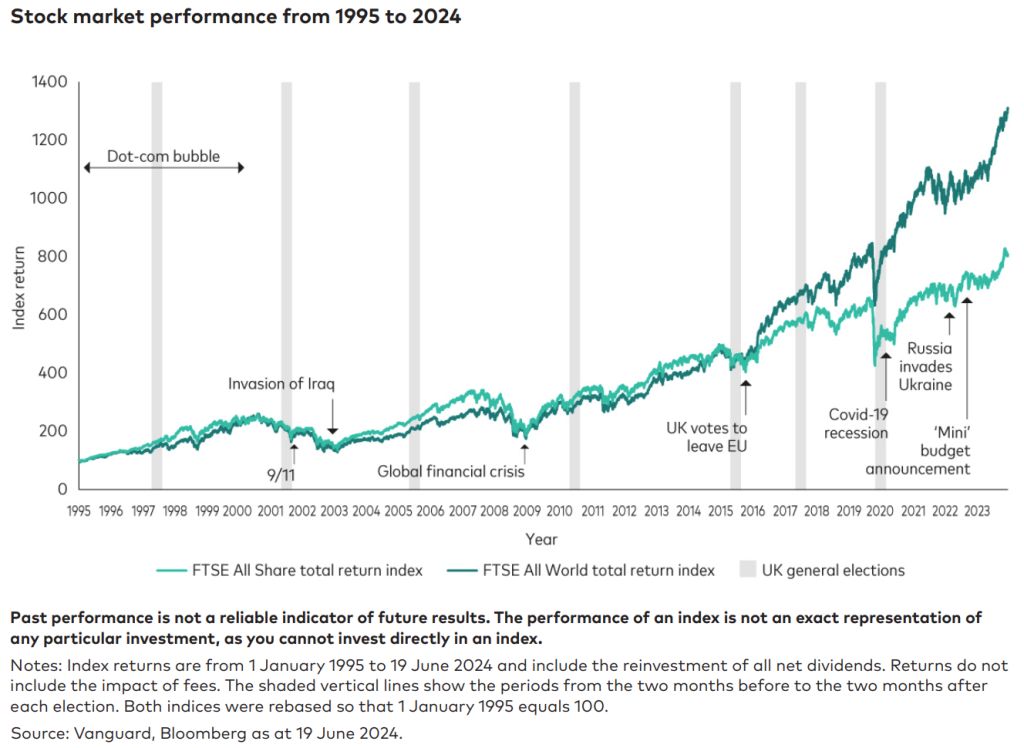
Assessing the implications of a new government and then trying to profit by timing the market rarely works, even for seasoned professionals.
Hopefully the above illustrates that planning with your long term goals in mind, keeping perspective and being disciplined are likely far more rewarding.
Hopefully the above illustrates that planning with your long term goals in mind, keeping perspective and being disciplined are likely far more rewarding.
Risks : Buying Investments can involve risk. The value of your Investments and the income from them can go down as well as up and is not guaranteed at anytime. You may not get back the full amount you invested. Information on past performance is not a reliable indicator for future performance. This information is intended for educational purposes and should not be considered a recommendation to buy or sell a particular security. The views expressed here are subject to change without notice and we can’t accept any liability for any loss arising directly or indirectly from any use of it.
To discuss your financial requirements or obtain other information click below
Share this article with your friends by clicking below

UK INFLATION AND INTERET RATE EXPECTATIONS
I am sure you are likely aware of the Bank of England increase to interest rates from 2.25% to 3% yesterday.
We are often asked about Interest rate expectations given that many of our clients have mortgages.
It may be somewhat reassuring that the Bank of England expect key measures of inflation to fall moving forward.
Here a few interesting graphs:
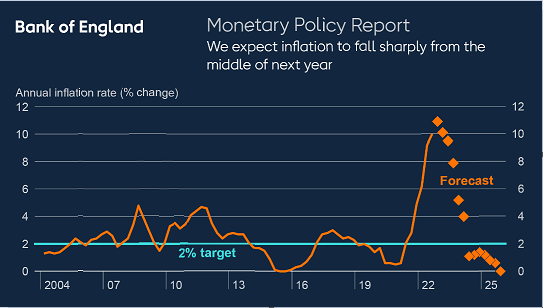
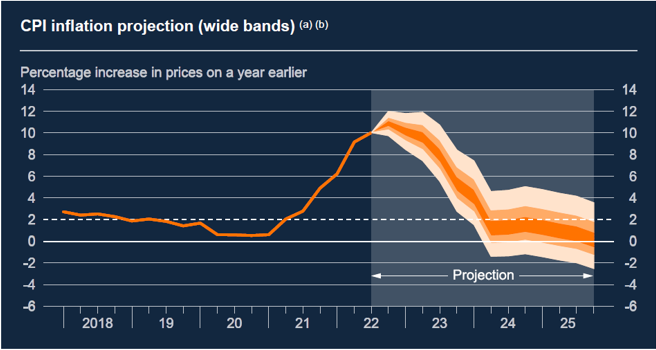
Source: Bank of England
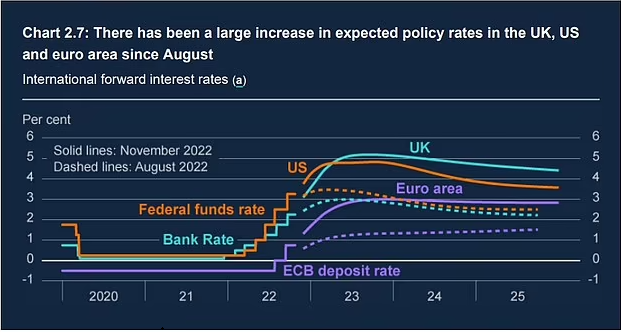
The UK is not alone in tackling inflation/interest rates
as can be seen here:
Source: Bloomberg Finance L.P. and Bank calculations
MARKET INSIGHTS: THE WEATHER IS CHANGING
The weather certainly feels like it has changed recently, hence I wanted to send an update on investment markets.
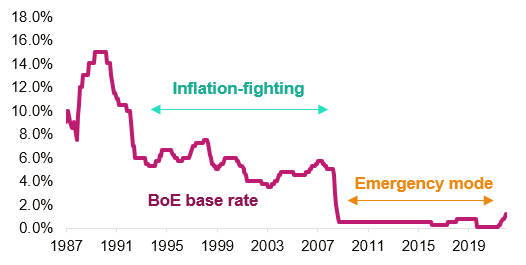
The battle against inflation has continued, Central Banks pushed through more Interest Rate hikes last month, the market barely flinched. Still firmly entrenched in Emergency Mode, interest rates will continue to rise until prices start to fall, which if course is going to have consequences for growth. A rate environment like pre-crisis is the most likely outcome, but there is going to be a fair bit of pain before we get there:
Inflation (CPI came in particularly high at 10.1%, with a 12.6% annual increase in food prices driving the reading above all estimates. This is up from 9.4% in June and marks the first time that UK prices have risen by double digits year-on-year since 1982. Given the implications this has for monetary policy, a sell-off in sterling-denominated assets followed, with the probability of a 75bp BoE interest rate hike increasing to around 30%. With further inflationary pressure expected from the energy price cap rises later this year, the outlook is left looking fragile, with the brutal squeeze on purchasing power far from over. While UK consumer confidence reading fell to a 50 year low on Friday coming in at –44, UK retail sales Ex Auto/ Fuel came in much better than expected at 0.4%.
The drought will no doubt exacerbate the problem further - farmers are finding life extremely challenging, with impending food shortage on top of ongoing energy disruption.
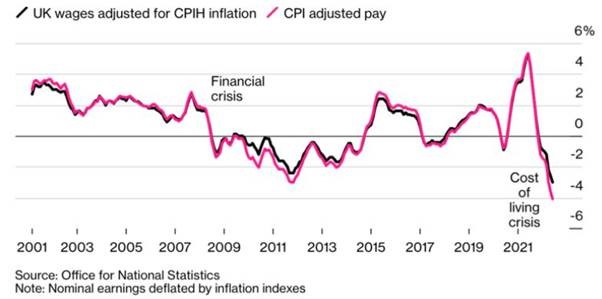
Thought this was quite a scary chart – REAL pay in the UK is falling at the fastest pace in 21 years.
Flash estimates suggested that euro zone GDP grew 3.9% year-on-year in Q2, below expectations and slightly down from the previous quarter. Inflation, on the other hand, remained persistent, with final HICP inflation at 8.9% for July as the region continues to suffer from the ramifications of Ukraine’s ongoing conflict with Russia.
In the month to July, US retail sales were unchanged, indicating that a degree of robustness remains among households. Unfortunately, the housing market is not displaying the same strength, with homebuilding squashed to the lowest level in over a year by high mortgage rates and construction material costs, muddying the country’s outlook. In line with these mixed signals, FOMC minutes were firm on inflation but acknowledged the wider economic implications of persistently aggressive policy. As a result, the committee resolved to continue hiking rates until inflation starts to decline but noted it may be appropriate for the pace of these increases to slow at some point, in order to assess their impact on the economy. This followed last week’s cooler inflation figure, which the market interpreted as a reduction in the likelihood of a 75bp September hike (measured at 40% post-release, down from around 50% before).
Equity markets are largely flat on the week while volumes remain low, having deteriorated throughout summer to the extent that movements are amplified. Earnings season is drawing to a close, with over 94% of the S&P 500 and 85% of EuroStoxx 600 now reported. Notably, although Target’s earning miss this week was not as bad as feared, following their earlier profit warning, it has renewed the focus on inventory and margin headwinds after the company was forced to slash prices to clear excess stock. As a result, it is possible that earnings estimates may need to be revised downwards in the coming months.
In China, the PBoC unexpectedly loosened monetary policy, cutting its medium-term lending rate by 10bps to 2.75% in an attempt to spur economic activity. This came after the announcement of surprisingly weak retail sales and industrial output growth as both consumer and business confidence have been depressed by COVID measures and the property market crisis. Now faced with structurally weak credit demand, evidenced by new yuan loans falling dramatically in July, policymakers are constrained by fears of stoking inflation. For now, in addition to the rate cut, Premier Li Keqiang has urged six major provinces to boost growth measures and balance COVID restrictions with economic performance whilst Chinese regulators look to guarantee bond issuance by property developers in an effort to buoy a systemically significant industry for the country.
Oil prices fell roughly 2% this week as the relatively weaker global economic outlook dampened demand while supply looks set to expand, with increased US shale production, rebounding Libyan production, and a potential nuclear agreement with Iran which would permit more oil exports.
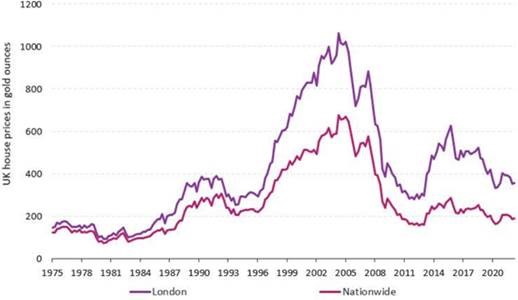
There’s been plenty in the press about slowing annual house price growth. What if you were to lot a chart showing how many ounces of gold you need to buy a house in the UK? Prices are not as lofty as you might think in those terms.
Risks : Buying Investments can involve risk. The value of your Investments and the income from them can go down as well as up and is not guaranteed at anytime. You may not get back the full amount you invested. Information on past performance is not a reliable indicator for future performance. This information is intended for educational purposes and should not be considered a recommendation to buy or sell a particular security. The views expressed here are subject to change without notice and we can’t accept any liability for any loss arising directly or indirectly from any use of it.
To discuss your financial requirements or obtain other information click below
MARKET INSIGHTS: MORE UNIQUE AND COMPELLING OPPORTUNITIES THAN SEEN IN YEARS
Markets have begun plotting a path to recovery. Yet, the economy is in a dire state with significant uncertainty.
We work with you and the best investment management teams to achieve your objectives.
Hear directly from Morningstar who explain where they see opportunities ahead.
Risks : Buying Investments can involve risk. The value of your Investments and the income from them can go down as well as up and is not guaranteed at anytime. You may not get back the full amount you invested. Information on past performance is not a reliable indicator for future performance. This information is intended for educational purposes and should not be considered a recommendation to buy or sell a particular security. The views expressed here are subject to change without notice and we can’t accept any liability for any loss arising directly or indirectly from any use of it.
To discuss your financial requirements or obtain other information click below